
In his book Empowered: Ordinary People, Extraordinary Products, Marty Cagan recommends that aspiring product managers get CSPO-certified early in their careers. I want to share what you can actually expect from this training and certification — beyond collecting yet another badge (and a rather pricey one at that).
The training runs for two full days. The first day covers the fundamentals of Agile and Scrum through group exercises, with a brief overview of other product development methodologies. For those just entering the profession, this day is genuinely valuable — it builds a deeper, more grounded understanding of Scrum. That knowledge serves as a useful foundation for evaluating and comparing the processes at your own company or within your product.
More experienced product managers will find it helpful for formalizing and structuring what they already know. Most of us work directly with development teams, and a fresh infusion of ideas can bring new creativity and engagement to the team.
The second day is more interesting, since the material focuses exclusively on the work of the product owner.
A quick note worth making here: product owner is one of the defined roles in Scrum. The goal of the person in this role is to maximize the value of the product — for users and for the business. You’ll sometimes find opinions online (including from fairly well-known product people) that the PO’s job is nothing more than shuffling tasks around in the product backlog. That’s not true, of course. But since every company has different development processes and organizational structures, the PO role can get split across multiple people — which means you might end up with someone called a «PO» who really does nothing but move tickets around in the backlog (while a developer colleague moves JSON around :).
Anyway, the second day covers practices for defining product goals and product vision, the Lean Startup concept, approaches to testing value and growth hypotheses, and product roadmap development. It also covers best practices for writing User Stories and building User Story Maps. After each module, there’s time to reflect on what was covered and write down your key takeaways.
If you’re thinking about committing a couple of days to this training, here are a few tips:
- Choose an in-person training over an online one. It leads to greater engagement and, as a result, better outcomes.
- Choose an English-speaking trainer. Most of the materials you’ll keep coming back to with new questions — books, videos, articles — aren’t translated into Russian. Better to get comfortable with the original terminology from the start.
- Even if you’re an experienced product manager, try to stay fully engaged throughout. First, new ideas will come to you. Second, your own experience and knowledge can be valuable to other participants — share it generously and respectfully.
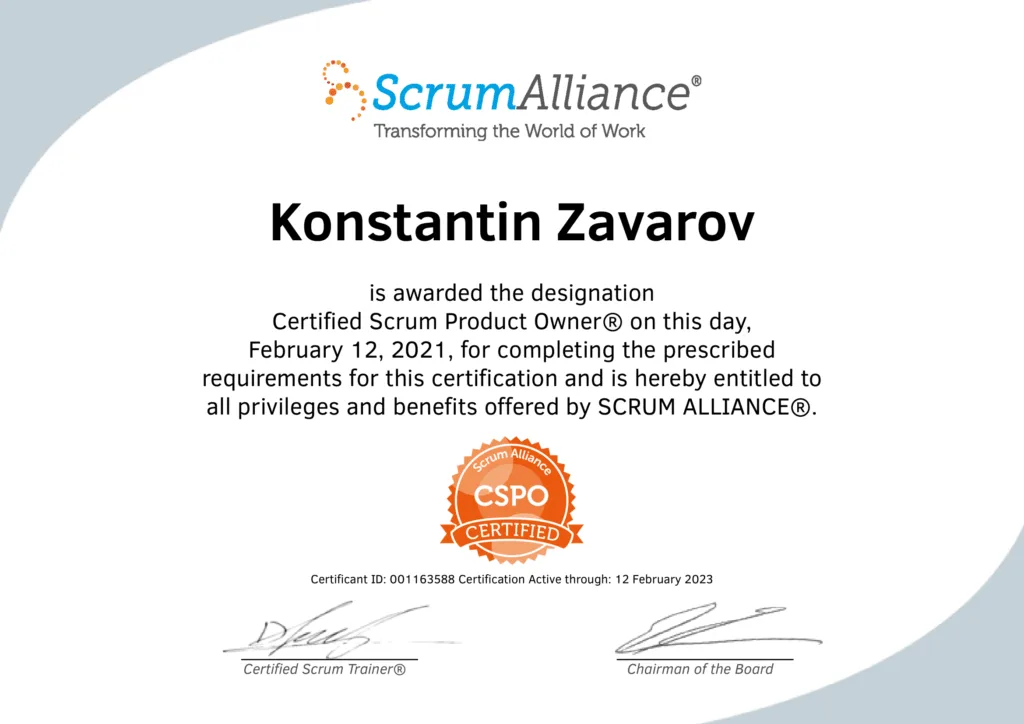
And in the end, you’ll walk away with an official piece of paper. Difficulty: 1/10. Cost: 7/10. Usefulness: you decide.